
Matrix system of fluidic communication and movement of the body as a whole.
Dr. A.T Still, the founder of osteopathy, wrote:
“I write at length about the universality of the fascia in order to impress the reader with the idea that this connecting substance must be free in all its parts in order to receive and secrete all fluids, regulate and use them in preserving the life of animals. A knowledge of the extent of the universality of the fascia is indispensable, and it One of the greatest aids to those who seek to locate the cause of the disease..” (1902)
“… I know of no part of the body that equals the fascia as a hunting ground.
I believe that as the study of the fascia will progress, rich golden thoughts will appear to the ‘spirit’s eye’ more than for any other part of the body”.
(Andrew Taylor Still, 1900)

On the website of the Language Academy the term fascia is translated as ‘diaper’ or ‘swaddle’, in other places it may also appear as ‘facia’ or ‘fatsia’.
The origin of the word is in the Latin language and means ‘unite’.
The anatomical definition of fascia is:
The fibers of the connective tissues are mainly derived from collagens that unite and produce layers of ligaments under the skin in order to connect, stabilize, separate and close muscles and other internal organs. (Martin 1998)
The fascia is described in various ways:
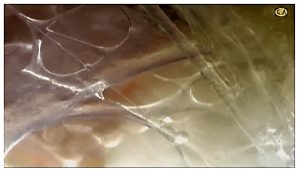
- The fascia is a body stocking ,like a plastic bag under the skin, which helps hold us together as one piece.
The superficial fascia is indeed such a “bag” – does form a body stocking.
- The fascia is described as tubes within tubes within tubes.
The meningeal layers make up the different tubes.
- The fascia is also described as series of lamina- sequence of coatings/layers (connectors) which unite, separate into envelopes and unite again. Each structure in the body has its own individual envelope made of fascia, which is created by separating two or more layers of fascial lamina.
The fascia has essential roles:
- Creating the structure/configuration of the whole human body.
- Enabling the movement of the human body (it stores the muscle fibers inside it and allows them to move and thus move the skeleton. If it is stuck (adhesion) we lose range of motion.
- Serves as a communication system and management of the energy network throughout the body as a whole.
- Stores and encapsulates cellular memory and enables the release of memories and traumas.
Fascia is a multidimensional system of different connective tissues that were created and are being created from the moment of our birth until our death.
Fascia is built and acts as a human matrix in the human body in a multidimensional way.
Fascia keeps the liver from falling out, the intestines from falling down into the bottom of the pelvis.
Fascia the tiniest nerves has its own fascial sheath or envelope, as well as the largest bone.
Fascia the health of the muscular attachments of the body is related to fascia, which means that muscle tone or the state of contraction, have a lot to do, with how tight or loose the fascial sheath and envelopes are in certain areas of the body at any given time.
Fascia in the locomotor system is semi-fluid (synovial fluid) and is made up of different protein densities which we know by names: bone, ligament, tendon, capsule, envelopes of the nervous systems and organs of the entire human body (viscera).
Fascia serves as the communication system of the body as the “spokesperson and manager” of the “energy network” in the whole body as a whole.
Acts as a “bio-tensegrity” of constant tension and integrational organization.
Goes continuously from the head to the feet, from the stomach to the back.
It is transverse as well as diagonal and it connects, like “anatomical trains” with many tracks.
It connects at all levels of function, the processes of pain, memories and emotion between the brain and the body.
Fascia makes up about 40% of the total body weight and 30% of the muscle mass.
It is plastic and elastic according to the structure of the mesoderm (elastin and collagen respectively) and its great sensitivity allows it to change very quickly in response to heat and cold, which harm both its form and its ability to function (when the fascia dries out, we lose the range of motion, pain and inflammation appear.)
Fascia remembers every injury, trauma, change or experience. It reacts to any change, adapts in response to the body’s condition and will always try to return the body to a state of balance even with sometimes as “simulated balance”. In this process, the connective tissue and the muscles work together to “help” their muscle partners in a parallel area that signals a load. Something that can manifest itself in pain and weakness or muscle contraction.
The physical and emotional-mental-behavioral effects of the fascia on our existence:
On the physical level:
When the fascia dries out, it becomes, together with the fat cells, a glue that limits the movement of the fibers.
We lose the range of motion, there is a decrease in the entire movement system, pain and of course inflammations appear.
The fascia should be lubricated (synovial fluid) to maintain its elasticity and mobility. Also, preserve the gliding and sliding mobility between it and the interstitial fluid.
In the case of a shortened or stretched fascia, due to dehydration, there will immediate and a direct effect on the organ/part it wraps.
When it comes to muscle fibers, the adhesions will limit their movement and keep them in their shortened state, reducing their range of motion and the range of motion of the joints.
At the emotional-mental-behavioral level:
When the fascia dries out, it encapsulates the pain, movement memories and emotions.
These lead to the formation of inflammations, changes in the body’s ability to move and its posture, and from there to disrupting the length of life and its quality.
The emotional-mental-behavioral and physical aspects work with each other, in constant synchronization without a break, throughout our lives.
Any action aimed at one will affect the other (the whole body).
The softness and flow within the fascia are extremely significant for dealing with diseases and infections.
Fascia wraps organs through which blood vessels and lymph pass.
When the fascia is at its best, the passages are freer and the conduction of the immune system cells is more fluid. Movement, warmth and working with Embodiment affect the fascia, are essential to it, and therefore essential to all body systems.
3 Types of fascia:
- Superficial fascia
Is under the skin in most parts of the body, serves as a reservoir of water and fat and a passage for to the blood vessels, lymph and nerves; Insulates and protects the body from the outside. It is like a layer that changes its shape and with every movement of
the body it transmits information. The superficial fascia is the horizontal layer.
The superficial fascia has the ability to slide (glide) which is possible between the Scarpa fascia epidermis (the upper layer of the skin) to the superficial layer of the fascia (superficial) and to the blood vessels and sensory function.
The superficial fascia is elastic.
The superficial fascia has elastin which is a protein with elastic properties that allow the tissue to return to its original shape after stretching or contraction.
Elastin is a central component of the elastic fibers in the connective tissues.
The gene that codes for elastin in human is ELN
Elastin is a protein rich in hydrophobic amino acids.
Elastin is found in the skin, in the large arteries and arteriosclerosis (helps the artery wall withstand high blood pressure), in the lungs, in ligaments, in the bladder and in cartilage.
- Loose connective tissue – enables lubrication which enables the sliding system (slide&glide)
- Superficial Fascia visceralis
Holds each internal organ in its space and surrounds it closely. Consists of two layers of serum membrane. The outer membrane is called lateral and the one close to the organ itself is called visceral. Each organ has a corresponding serum membrane, the membranes of the brain, the pericardium, the lung membrane and the peritoneum in the abdominal cavity.
Tendon bands myofascia (around the muscles) the outer and inner layers of the bones.
Wraps and protects the muscles, joints and bones.
Partially also wraps around organs.
- Deep fascia
Dense – dense fibrous connective tissue that surrounds most of the internal parts of the body and connects them with ligaments, tendons and more. enables stability.
The deep fascia is for motor skills, movement and muscle stability.
Fascia is deep, wide, thicker, stiffer and less elastic.
Deep fascia contains the collagen fiber. Collagen is the most common protein in the human body. It is produced by the liver throughout life, but starting to slow down it’s natural production around the age of 30.
Fascia – is a collective concept that includes: bones, cartilage, fat, blood and lymph.
Fascia – with three types: superficial, superficial visceral and deep.
Fascia – it has protein collagenous and elastic fibers, and a fluid substance
(viscous and sticky made of types of proteins).
Fascia – it has unique cells: fibroblasts and immune cells.
Fascia – the combination of solid fibers to viscous sticky fluids defines the continuity of the connective tissues.
Fascia – its layers are like in weaving, producing a strong fibrous network system for the whole body.
Fascia – moves and slides with the interstitial fluid.
Fascia – is a system of many layers where each layer interacts with the other layers.
Each layer has a different direction and function.
Fascia – the three layers of fascia in inter-relations and are joined together to stabilize
relations between mobility (movement) to stability.
Fascia – the more sticky/viscous the fascia layers become, the more tension accumulates in the tissues, stiffness, and increased nerve stimulation. All the nerves pass through holes, so if there is less fluidity between the layers and the fibers, the layers become more dense, so the nerves will be compressed and irritated.
Fascia – between the superficial and deep there is no fat, except in adults who are very, very fat and then fat is formed between the layers of the fascia, therefore more tension density stiffness and less fluidity. The skin then, will become more as “cellulite”.
Fascia – constitutes the entire body as one unit. It can be felt as movement as a whole unit.
Fascia – Overall throughout the body is a kind of sensory-communicative “organ”.
Fascia – living matrix; Well connected to the cellular and intercellular matrix.
Fascia – is a system of communicative connective tissues.
Fascia – anatomical trains: longitudinal, transverse, spiral and diagonal (Tom Myers).
Fascia – has the ability to produce a system of order and continuity .
Fascia – for the most part, the orientation of the fibers of the fascia is longitudinal
(along the body).
Fascia – in the three diaphragms – the pelvis, the respiratory and the upper – the orientation of the fibers of the fascia is transverse And they serve as support for the body and prevent involuntary expansion of the upper body (torso).
Fascia – all parts of the body are connected to each other through it.
Fascia – also functions as a “vehicle” anywhere in the body.
Fascia – it is somewhat mobile.
Fascia – allows gross movements, such as kicking a ball, the heartbeat and the expansion of the lungs.
Fascia – allows physiological movement and subtle movements, with little or no resistance
at all.
Fascia – responds to respiratory effort and the pumping of blood along the body.
Fascia – Fascia also allows for more subtle physiological movements, such as turning in and out of
the whole body in relation to the flexion and extension activities
(the exhalation) of the craniosacral system.
In Craniosacral:
The Dural system RTM – longitudinal and transverse.
The 3-diaphragm system – transverse (and partially longitudinal in the ligaments).
The visceral system – Envelopes of the thoracic and abdominal cavities.
Envelopes of the organs.
The whole body as one whole unit of fascia and fluid.


